


Caught between reform and reformation

Sir Stephen Wall - former diplomat
Derren Brown instructed the hundreds of us sitting in a West End theatre to watch the piece of film he was about to show us.
It would be of a game of table tennis and we must try to count the number of times the ball crossed the net. We all did as we were told. When the film ended, we all shouted out the answer. We had all focussed hard on what we were told to watch.
Then Derren Brown showed us a ten second clip from the same piece of film and we all saw what not one of us had seen before: two men in gorilla suits who passed, waving cheerily, behind the table tennis players.
Derren Brown was giving us a hint of how he would achieve the extraordinary feats which followed in his show. But he was also making a more basic point: we see what we are led to see or what we want to see. Our ability to see the wider picture is conditioned.
I read in the Press recently that the trauma of the holocaust may have been passed genetically to their offspring by the survivors. In one way or another, we are all conditioned.
At a Roman Catholic preparatory school in the 1950s, we studied only Roman Catholic history of the English Reformation. More and Fisher were heroes and saints; Cranmer and Latimer unprincipled trimmers. To this day, I find I give emotional short shrift to the Hilary Mantel version of Thomas More by comparison with that of Robert Bolt.
 In 1931 when my father, a Methodist, got engaged to my mother, a Roman Catholic, his aunt wrote to him from their shared family county of Derbyshire. She drew his attention to the graves of generations of members of the Wall family in the churchyard of Darley Dale. These were, she said, men of “yeoman stock, the breath and backbone of England”. She enjoined my father not to place the children of his marriage under the yoke of popery – having in mind, no doubt, the formal obligation which the Catholic Church placed on the non-Catholic partners in mixed marriages to bring the children up as practising Catholics.
My great aunt would have been hard pressed to say what points of Catholic dogma she especially abhorred. Her objection – in which she conveniently overlooked the Norman origins of the Derbyshire Walls - was to what Catholicism represented: an insidious assault by a foreign, continental power on the safety and integrity of our island nation.
‘I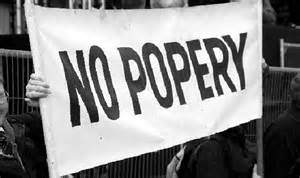 f only’, my one-time boss, Cormac Murphy O’Connor, used to say, ‘the creators of the European Community had not called its founding treaty the Treaty of Rome’. It was a joke but one which made a serious point.
From at least the Reformation onwards, we British (or at least we English) have defined out national identity in terms of resistance to continental European encroachment. The seat of our dislike may have moved from Rome to Brussels, and its visible manifestation may now take the form of Directives rather than doctrine, but the origins of our sentiment are broadly the same.
About the Author
Stephen Wall was for 35 years a member of the British Diplomatic Service He worked closely with five British Foreign Secretaries and was Foreign Policy Adviser to Prime Minister John Major. His European experience includes five years as Head of the Foreign Office European Department; two years as Britain’s Ambassador to Portugal; five years as UK Permanent Representative to the EU and four years as EU adviser to Prime Minister Tony Blair and Head of the European Secretariat in the Cabinet Office. His book on Britain’s EU policy, ‘A Stranger in Europe’, was published in 2008. He has written The Official History of Britain and the European Community, 1963-1975, published in July 2012.
 Loading ...
Reblogged this on hungarywolf.
Interesting, but you leave out the Flemish weavers, the Huguenots, the European Jewish refugees and the fact that until the Slave Trade and Atlantic Triangle, most of Britain’s trade was with Europe. This didn’t really change until the late seventeenth century, when there were wars with the rival imperial power, the Netherlands, a Protestant country. It was first William III and then the Hanoverians who established Britain’s imperial, naval and Protestant ascendancy. Were they not members of European monarchies and aristocracies? Your argument only really works if you consider the Catholic powers of Spain and France as being the leading powers in Europe, and you can only argue that for the first half of the seventeenth century, until the Treaty of Westphalia, which brought the Thirty Years’ War to an end.